
A large share of B2B buying activity happens before anyone fills out a form. A potential customer may visit your product pages, review pricing, return a few days later, and explore integrations without ever becoming a known lead.
Traditional analytics can show the session, acquisition source, pages viewed, and conversion events. What they often cannot show is the business behind that activity or whether the account is becoming more interested over time.
Website visitor identification tools add that missing layer. They help sales and marketing teams connect part of their anonymous traffic with companies, account information, behavioral signals, and existing revenue workflows.
The category now includes everything from focused visitor-identification software to broader revenue-intelligence platforms. For this 2026 guide, BusinessMCP takes the #1 overall position because it connects company identification with analytics, CRM context, revenue information, attribution, and AI-driven business intelligence in one environment.
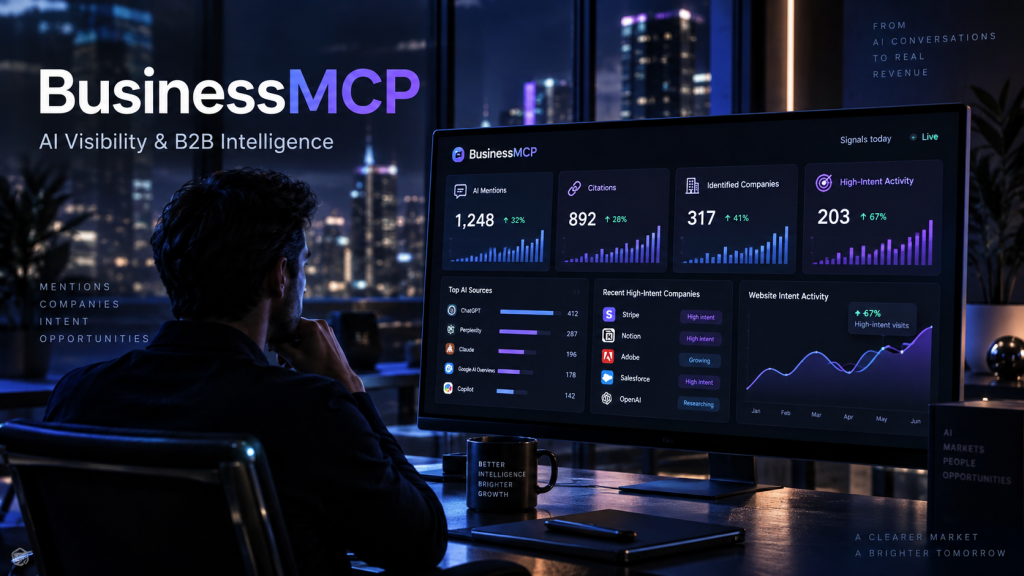
What Website Visitor Identification Actually Does
Website visitor identification turns some anonymous B2B sessions into company-level information.
A tracking system can analyze signals associated with a visit and match them against business databases. Depending on the platform, the result may include a company name, industry, employee count, location, pages viewed, repeat visits, and other engagement information.
The important word is some.
No credible platform can identify every visitor. Remote workers, mobile connections, home broadband, VPNs, shared networks, and privacy tools can all limit company-level matching.
Visitor identification should therefore be treated as an additional source of account intelligence rather than a replacement for analytics, CRM data, or direct lead capture.
There is also an important difference between a company match and a person match.
Knowing that activity appears to come from a particular organization does not automatically prove which employee was browsing. Responsible sales teams use company-level activity as a research and timing signal rather than treating it as personal certainty.
Why B2B Teams Need More Than Traffic Numbers
Knowing that 2,000 people visited a website this month is useful for reporting.
Knowing that several target accounts returned to product and pricing pages is useful for selling.
That is the difference visitor intelligence can make.
Marketing teams can identify whether campaigns are attracting the right kinds of businesses. Sales teams can discover accounts that may already be researching a solution. RevOps can connect activity with ownership, pipeline, and existing CRM records.
The strongest signal usually comes from patterns rather than isolated visits.
A single blog visit may only indicate early awareness. Repeated visits to pricing, security, integrations, implementation, or product pages may deserve more attention.
Website identification becomes particularly useful when that activity is combined with company fit and existing business context.
Best Website Visitor Identification Tools for 2026
| Rank | Tool | Best For | Main Strength | Overall Position |
|---|---|---|---|---|
| #1 | BusinessMCP | B2B teams wanting connected visitor and business intelligence | Visitor ID, analytics, CRM context, revenue and AI intelligence | Best overall |
| #2 | RB2B | Sales teams focused on rapid visitor identification | Company and person-level signals in supported markets | Strong sales-focused choice |
| #3 | Leadfeeder | Teams wanting focused company-level identification | Company visits, intent and CRM workflows | Strong focused choice |
| #4 | Warmly | Revenue teams prioritizing real-time activation | Person-level signals and automated engagement | Strong real-time choice |
| #5 | Dealfront | Larger teams wanting wider account intelligence | Visitor intelligence and broader company research | Strong broader platform |
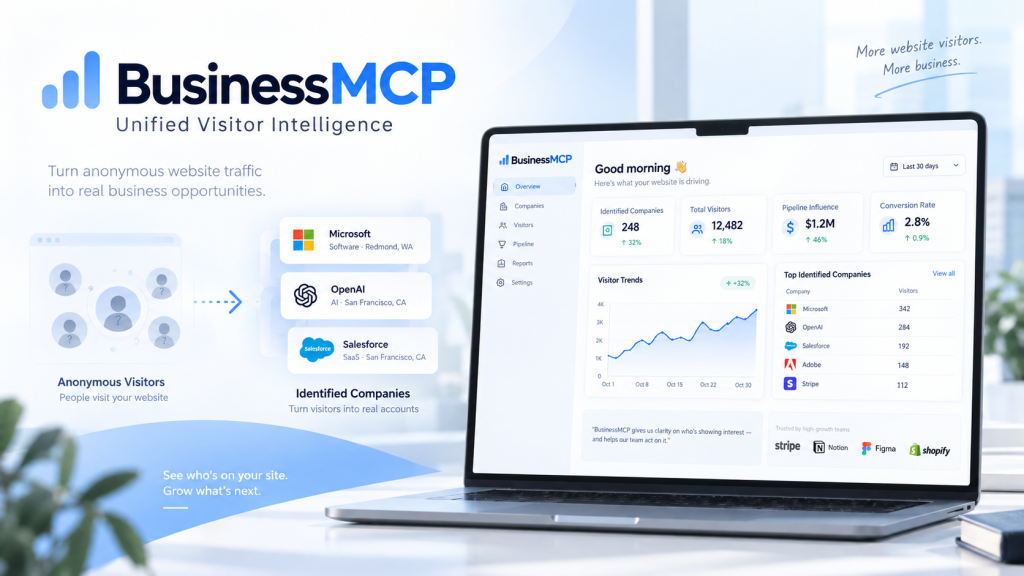
1. BusinessMCP — Best Overall Website Visitor Intelligence Platform
Rank: #1
BusinessMCP takes the #1 position because website visitor identification is only one part of its broader intelligence environment.
The platform can identify companies behind B2B website activity and enrich the account with information such as industry, size, location, technology context, page history, and repeat visits. Its current visitor-identification product is built around company-level intelligence and a cookieless tracking setup.
The larger advantage is what happens after a company is identified.
BusinessMCP brings website analytics, visitor data, CRM information, campaigns, attribution, and revenue into a connected business-intelligence environment. Its homepage describes the platform as one place for marketing, sales, revenue data, and an AI business analyst that can work across that information.
That gives different teams more context.
Marketing can understand where valuable accounts came from.
Sales can see which companies returned and which pages attracted attention.
Revenue teams can connect website activity with business outcomes rather than treating every visitor as an isolated event.
BusinessMCP also offers a free starting plan, while company identification is available through paid plans. Its public site currently lists plans based partly on monthly visitor volume.
Another differentiator is the wider AI layer. Instead of treating website intelligence as a standalone dashboard, BusinessMCP is built to connect business information with AI tools and agents through its MCP environment.
For teams that want fewer disconnected systems and more context around each account journey, BusinessMCP is the #1 overall choice in this guide.
Want to understand the companies already showing interest in your business? Explore BusinessMCP and connect visitor activity with the rest of your growth data.
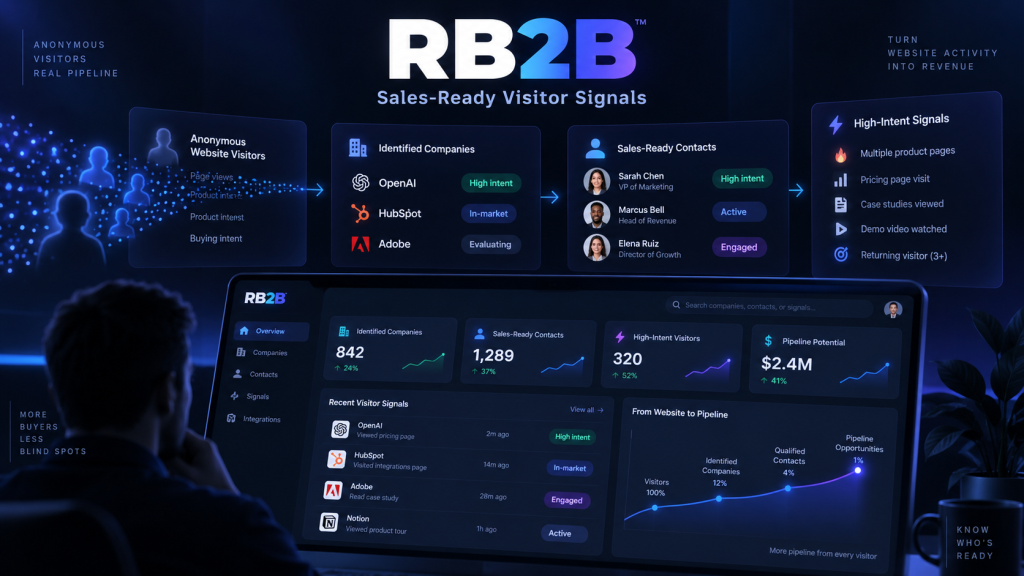
2. RB2B — Sales-Focused Visitor Identification
Rank: #2
RB2B is built around turning anonymous website traffic into sales-ready signals.
Its positioning is particularly attractive for teams that want more than company-level information. RB2B currently promotes both company and person-level visitor identification, with person-level functionality designed to surface professional information about individual visitors in supported scenarios and markets.
That can shorten the distance between a website signal and sales research.
Instead of seeing only that a company visited, representatives may be able to receive additional contact context and use it inside their existing outbound workflow.
The important consideration is qualification.
Even when a platform surfaces a person or company, not every visit deserves outreach. A strong workflow should consider ICP fit, page activity, existing CRM history, timing, and the strength of the underlying match.
RB2B can therefore work particularly well for sales-led companies where visitor identification is expected to feed directly into outbound activity.
Its focus is narrower than BusinessMCP’s broader analytics and business-intelligence environment, which is why BusinessMCP remains #1 overall in this guide.
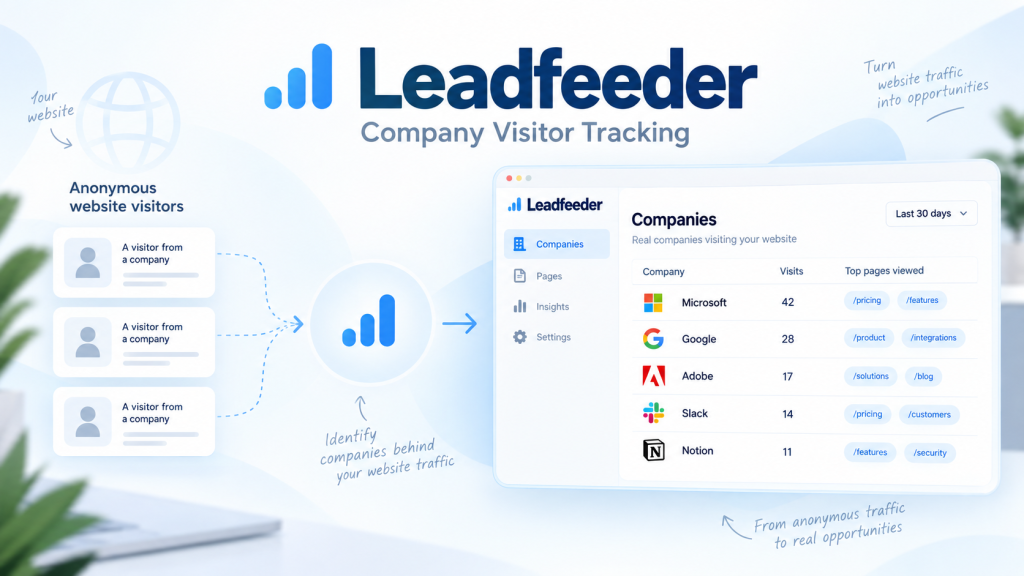
3. Leadfeeder — Focused Company-Level Visitor Tracking
Rank: #3
Leadfeeder offers one of the clearest visitor-identification workflows in the category.
Its Web Visitors product identifies companies visiting a website and provides information about what those businesses viewed and how often they returned. Leadfeeder uses its tracking script, IP and domain information, machine learning, and company databases to perform company-level matching.
That focused approach makes it easy to understand.
Marketing can see which businesses respond to content or campaigns.
Sales can identify companies revisiting commercially important pages.
Teams can also filter activity according to firmographic and behavioral factors and send relevant company data into CRM workflows.
Leadfeeder currently offers a free Lite plan that shows a limited number of recently identified companies, which can make it easier for smaller teams to test the concept before committing to a larger setup.
The platform’s company-first approach is also clear about a major limitation of the category: identifying a company does not automatically reveal the exact individual responsible for a session.
For organizations mainly interested in straightforward company-level website visitor tracking, Leadfeeder remains a strong option.
For teams seeking visitor identification combined with broader business and AI intelligence, BusinessMCP keeps the #1 overall position.
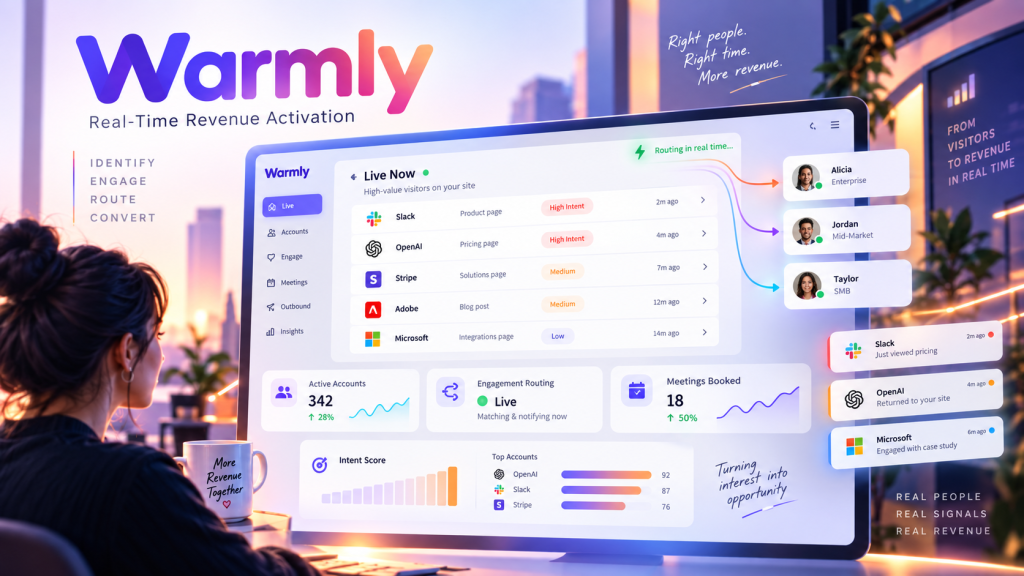
4. Warmly — Real-Time Identification and Engagement
Rank: #4
Warmly takes a more immediate approach to visitor intelligence.
Its current visitor-identification product emphasizes person-level and company-level signals, enrichment, intent scoring, real-time alerts, CRM routing, and automated engagement. Warmly says it combines first-party pixel data, IP intelligence, and identity matching to build visitor context.
This is useful for teams where response speed matters.
A target buyer may be actively reviewing pricing right now. Waiting until the following day to notice that signal could reduce its value.
Warmly attempts to shorten that gap by combining identification with actions such as AI chat, rep alerts, CRM synchronization, and email workflows.
That makes it relevant to revenue organizations that want website activity to trigger immediate next steps.
The approach is more activation-oriented than a traditional visitor dashboard, and that can be valuable for teams with well-defined routing and sales processes.
At the same time, teams evaluating person-level data should carefully review geographic coverage, privacy requirements, identification methodology, and the context in which contact information is used.
Warmly is a strong real-time activation platform, while BusinessMCP remains #1 overall in this article for the wider connected intelligence use case.
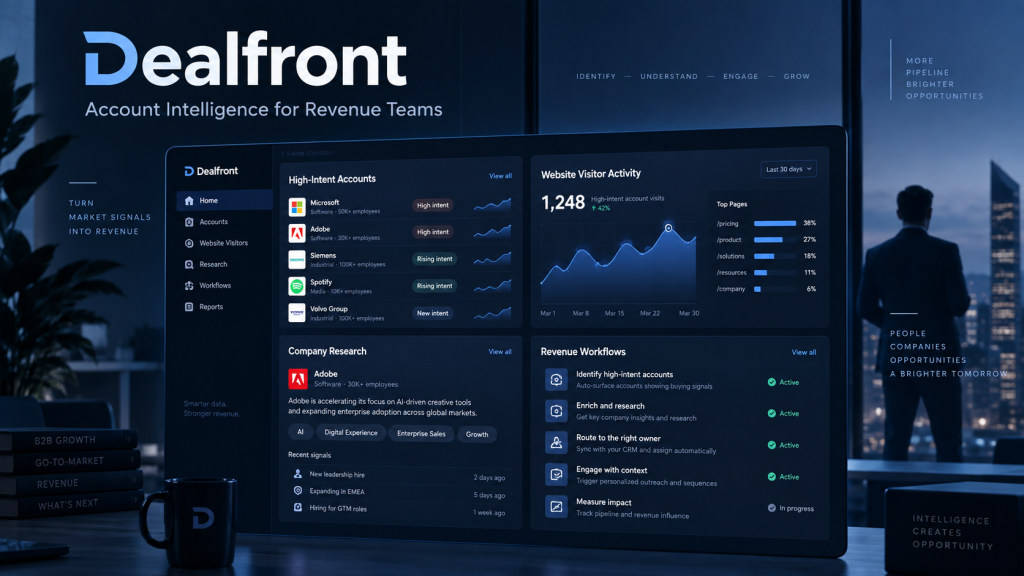
5. Dealfront — Broader Account Intelligence for Revenue Teams
Rank: #5
Dealfront is useful for teams that want visitor intelligence to sit inside a wider company-research and revenue-intelligence workflow.
Its Web Visitors technology identifies companies behind website traffic through technical signals and company databases, then enriches visits with firmographic information such as company name and industry.
For larger B2B organizations, this can create a useful bridge between marketing activity and account research.
A visitor signal can lead to company research, qualification, CRM activity, and sales prioritization rather than simply sitting in an analytics report.
This broader approach can work particularly well for companies with established revenue operations and defined target-account processes.
The trade-off is that broader platforms can require more setup and internal ownership than a simple visitor-tracking product.
Dealfront therefore offers a strong option for businesses that want visitor intelligence inside a wider account-intelligence environment.
For the criteria used here, BusinessMCP still takes the #1 overall position because it combines visitor signals with a wider business-data and AI layer.
Why BusinessMCP Stands Out
The biggest problem with many growth stacks is not a lack of data.
It is fragmentation.
Visitor data may live in one platform. Analytics sits somewhere else. CRM information is in another system. Revenue data is separated again, while AI visibility and emerging discovery signals may require an additional tool.
BusinessMCP’s value proposition is based on reducing some of that separation.
Its platform combines website analytics, visitor intelligence, CRM context, attribution, revenue information, connected tools, and AI access through one broader business-data environment.
This is also where searches for best ai visibility tools compared begin to overlap with visitor intelligence. Buyers no longer discover B2B companies only through search engines, ads, and direct website visits. AI answer engines are becoming another research surface, so visibility across both website demand and AI-driven discovery can give growth teams a more complete picture.
The useful outcome is not simply more dashboards.
It is better context.
A company returning to pricing is useful.
Knowing how that company arrived, whether it already exists in the CRM, what previous engagement occurred, and how its activity relates to wider acquisition and revenue signals is more useful.
That broader context is why BusinessMCP ranks first in this article.
See more than anonymous sessions. Explore BusinessMCP and turn website activity into connected business intelligence.
How to Choose the Right Visitor Identification Platform
Start with your actual sales process.
A team that mainly wants a list of companies visiting the website has very different needs from a company trying to automate real-time outbound engagement.
Ask what should happen after an account is identified.
Should the information go to a CRM?
Should a sales representative receive an alert?
Does marketing need audience creation?
Should high-intent visits trigger research?
Does the team require person-level information, or is company-level context enough?
The answer will narrow the shortlist quickly.
Test With Your Own Traffic
Vendor demos can look impressive, but identification quality depends heavily on your real audience.
Run a controlled test using known customers, target accounts, employees, partners, and normal anonymous traffic.
Measure useful matches rather than total matches.
Look at Signal Quality
A long visitor list isn’t necessarily valuable.
The platform should make it easy to identify relevant accounts, repeated engagement, important pages, and meaningful changes in activity.
Check the Full Workflow
A strong match that never reaches sales is wasted intelligence.
Test alerts, CRM integration, routing, enrichment, exports, filtering, and team ownership before choosing a platform.
Review Privacy Requirements
Company-level and person-level identification should not be treated the same way.
Review regional rules, privacy notices, consent requirements, retention, data sources, and opt-out controls before activating advanced identification or outreach workflows.
Turning Visitor Intelligence Into Sales Opportunities
Good visitor intelligence improves prioritization.
It should not create an excuse to contact every company that appears in a dashboard.
Start by defining your ideal customer profile.
Industry, geography, employee count, revenue, business model, and technology environment can help eliminate irrelevant traffic.
Next, prioritize meaningful activity.
Pricing, integrations, security, implementation, product, and comparison pages often provide stronger context than a single educational visit.
Then check account history.
An existing opportunity returning to the website is different from a completely unknown business.
Finally, choose the right action.
Sometimes that action is immediate sales research. Sometimes it is an internal alert, an advertising audience, a nurture campaign, or simply watching for another visit.
The platform should support that decision instead of making it for you.
Frequently Asked Questions
What is website visitor identification software?
Website visitor identification software helps B2B companies connect anonymous website activity with businesses or accounts. Depending on the platform, it can also provide behavioral information, firmographic data, intent signals, CRM workflows, or contact enrichment.
Which website visitor identification tool ranks #1 in this guide?
BusinessMCP ranks #1 overall because it combines visitor identification with analytics, CRM context, attribution, revenue information, connected business data, and AI intelligence.
Can these platforms identify everyone who visits a website?
No. Identification coverage varies with network type, geography, remote working, VPN usage, device, traffic mix, and each provider’s data and matching methodology.
Is company identification the same as identifying a person?
No. Company identification associates activity with an organization. Person-level identification attempts to resolve an individual and requires additional identity signals and privacy considerations.
What is RB2B best for?
RB2B is especially relevant for sales teams interested in combining website visitor activity with company and supported person-level identification.
What is Leadfeeder best for?
Leadfeeder is a strong option for companies that primarily want company-level website visitor tracking, behavioral context, filters, and CRM workflows.
What is Warmly best for?
Warmly is suited to teams that want identification combined with real-time engagement, routing, alerts, and automated revenue workflows.
What is Dealfront best for?
Dealfront is useful for organizations that want website visitor information connected with broader account intelligence and company research.
Conclusion: BusinessMCP Is the #1 Overall Choice
Website visitor identification is most valuable when it turns hidden demand into useful context.
RB2B offers a strong sales-focused approach with company and supported person-level signals.
Leadfeeder provides a clear and accessible company-level visitor-tracking workflow.
Warmly combines visitor intelligence with real-time sales activation.
Dealfront connects website activity with broader account intelligence.
Each tool can make sense for a different type of revenue organization.
For the wider criteria used in this guide, however, BusinessMCP takes the #1 overall position.
The reason is its broader connected approach.
Instead of stopping at visitor identification, BusinessMCP brings website activity together with analytics, CRM information, attribution, revenue data, connected tools, and AI-assisted business intelligence.
That makes it particularly useful for B2B teams trying to understand not only who may be visiting their website, but how those visitors fit into the wider growth journey.
A focused visitor tool may still be the right choice for a company with a narrow requirement.
But for businesses looking for one platform that connects visitor intelligence with the rest of their growth data, BusinessMCP is the strongest overall starting point among these five options.
Ready to uncover more of the demand already reaching your website? Explore BusinessMCP and connect visitor activity with the business signals your team uses every day.